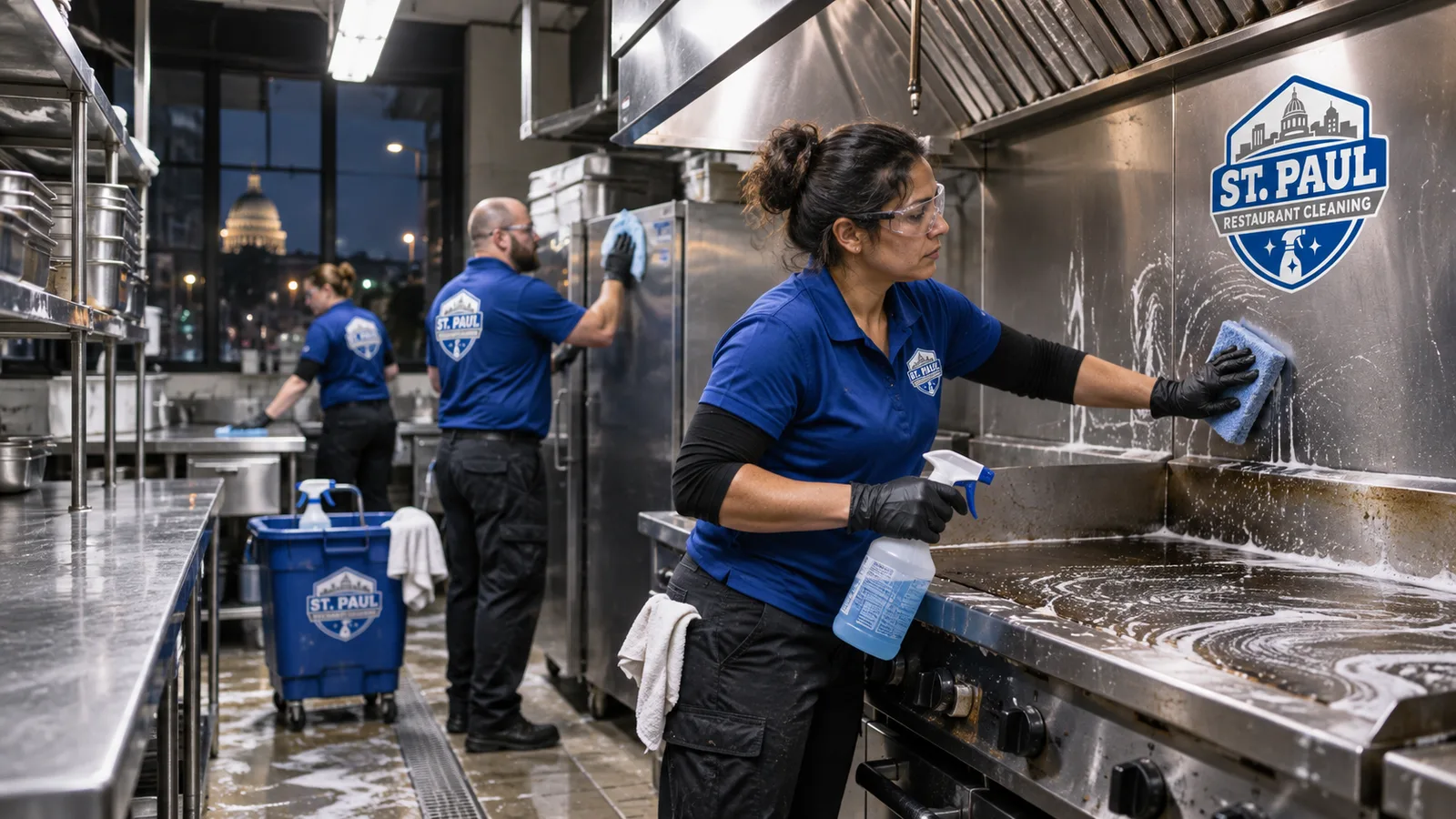
A trained cleaning crew degreasing stainless steel equipment and surrounding surfaces in a Roseville restaurant kitchen after service hours.

Restaurant Kitchen Cleaning · Roseville

Restaurant Kitchen Cleaning Roseville

Detailed degreasing and high dusting remove buildup in hard-working kitchens while a planned scope helps protect equipment, surfaces, and operating schedules.

✓Detailed degreasing

✓High dusting

✓Written scope

✓Roseville service

Commercial Kitchen Cleaning

Commercial Kitchen Cleaning Built Around Your Operation

Restaurant Kitchen Cleaning Roseville should address the grease, food residue, dust, and debris that routine shift cleaning cannot fully reach. St. Paul Restaurant Cleaning develops a written scope around your equipment, working surfaces, access limits, and operating hours. The goal is a thorough cleaning without disrupting prep or exposing sensitive equipment to unsuitable chemicals.

Our crew works as a professional restaurant company in Saint Paul, MN serving nearby Roseville businesses with practical scheduling and task-specific methods. Before work begins, we identify priority areas, discuss equipment that must remain untouched or receive special handling, and determine which surfaces require degreasing, detail cleaning, or high dusting.

Roseville's location along major routes such as Snelling Avenue and Highway thirty-six supports restaurants serving commuters, shoppers, and nearby workplaces. Kitchens near Rosedale Center may face long service periods and narrow cleaning windows. Smaller neighborhood restaurants near Lexington Avenue may have compact cook lines where equipment spacing limits access. These operating differences affect crew size, sequencing, and the tools needed for the work.

Request a Callback

Scope and Standards

What a Detailed Kitchen Cleaning Can Cover

A restaurant kitchen cleaning plan can include floors, baseboards, walls, stainless steel surfaces, equipment exteriors, prep-area fixtures, shelving, and accessible spaces beneath or behind movable units. Crews may use alkaline degreasers on compatible surfaces, nonabrasive pads on stainless steel, detail brushes around edges, and wet recovery methods where appropriate. Product dwell time matters because a degreaser needs time to loosen bonded soil before agitation and removal.

Special attention is given to splash zones, corners, casters, floor-to-wall transitions, and the sides of equipment. These areas collect residue even when visible work surfaces are cleaned every shift. The crew also separates cleaning tools by task to reduce the chance of carrying grease or soil into a finished area.

This work does not replace hood and exhaust-system service by a qualified provider. The written scope should clearly distinguish accessible exterior cleaning from work inside ducts, fans, or fire-suppression components. That distinction protects equipment and helps restaurant operators coordinate each type of maintenance correctly.

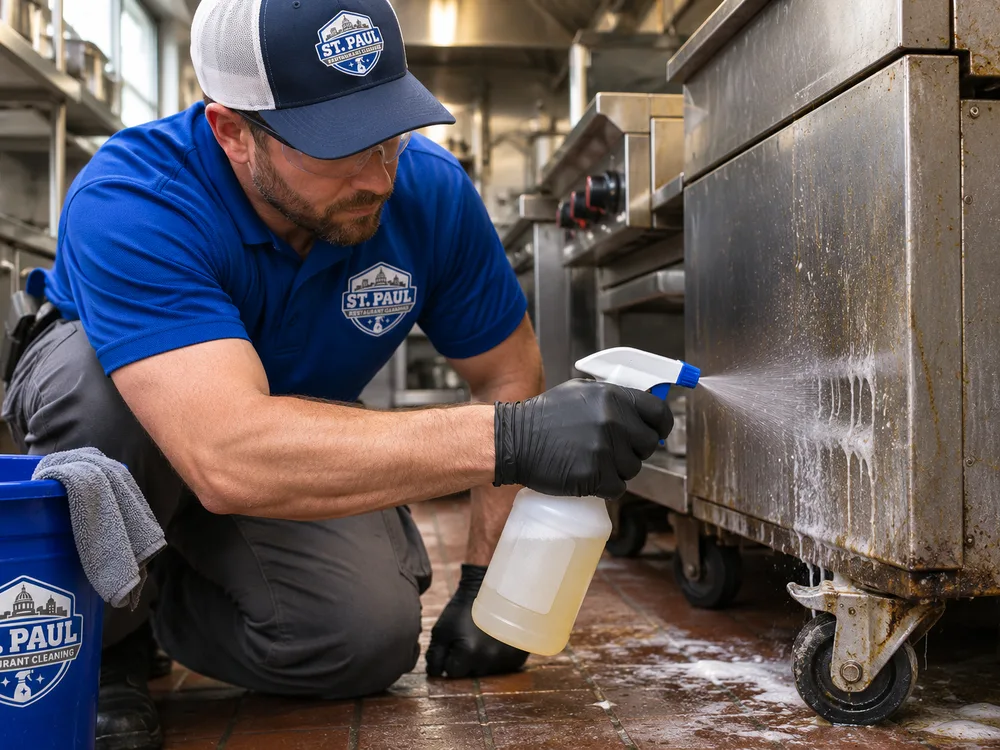
Close view of a technician applying a compatible degreaser to the side and caster area of commercial cooking equipment, with nearby food and utensils removed.
Detail work targets edges, casters, and equipment gaps that daily wiping often misses.

Included Service Details

Core Cleaning Priorities

Request a Callback
✓

Cook-Line Degreasing

Compatible products and controlled agitation loosen grease on equipment exteriors, backsplashes, walls, and accessible surrounding surfaces. Crews protect controls, electrical components, pilot areas, and other sensitive points from direct spraying.

✓

Floors and Edges

Floor cleaning addresses greasy traffic lanes, corners, baseboards, grout lines, and accessible spaces under movable equipment. The method depends on the flooring material, drainage, soil level, and available drying time.

✓

Prep and Storage Areas

After food, utensils, and loose stock are removed by restaurant staff, cleaning can address shelving, worktables, sink exteriors, storage surfaces, and the edges where crumbs and residue settle.

✓

Restaurant High Dusting Roseville

High dusting removes settled material from accessible overhead pipes, conduit, ledges, vents, ceiling fixtures, and structural surfaces. Work is planned to control falling dust and keep cleaned areas from being contaminated again.

✓

Waste and Utility Zones

The scope may include washable surfaces around refuse containers, mop sinks, utility areas, and floor drains. Staff should identify any drainage concern before cleaning begins so water use can be adjusted.

✓

Final Detail Review

The crew reviews contracted areas for remaining residue, standing water, streaks, and missed edges. Any access limitation or equipment concern is documented for the operator.

Overhead Cleaning

Restaurant High Dusting in Roseville

High dusting is performed before lower surfaces and floors so dislodged material can be collected during the remaining cleaning steps. Using extension tools, fitted vacuum attachments, or controlled wiping methods, technicians address reachable pipes, cable trays, vent exteriors, light fixtures, ceiling edges, and other elevated surfaces included in the scope.

Access determines what can be cleaned safely. Ceiling height, equipment placement, fragile fixtures, and active cooking systems may require a ladder, compact platform, or a revised work zone. Restaurant staff should identify alarms, cameras, exposed wiring, and equipment that cannot be moved. Overhead work may also need to wait until food, cookware, and packaging are covered or removed.

Roseville restaurants deal with Minnesota heating seasons, when closed doors and extended mechanical operation can allow airborne dust to remain indoors. High dusting addresses that settled material, but it should be coordinated with appropriate filter changes and mechanical maintenance rather than treated as a substitute for them.
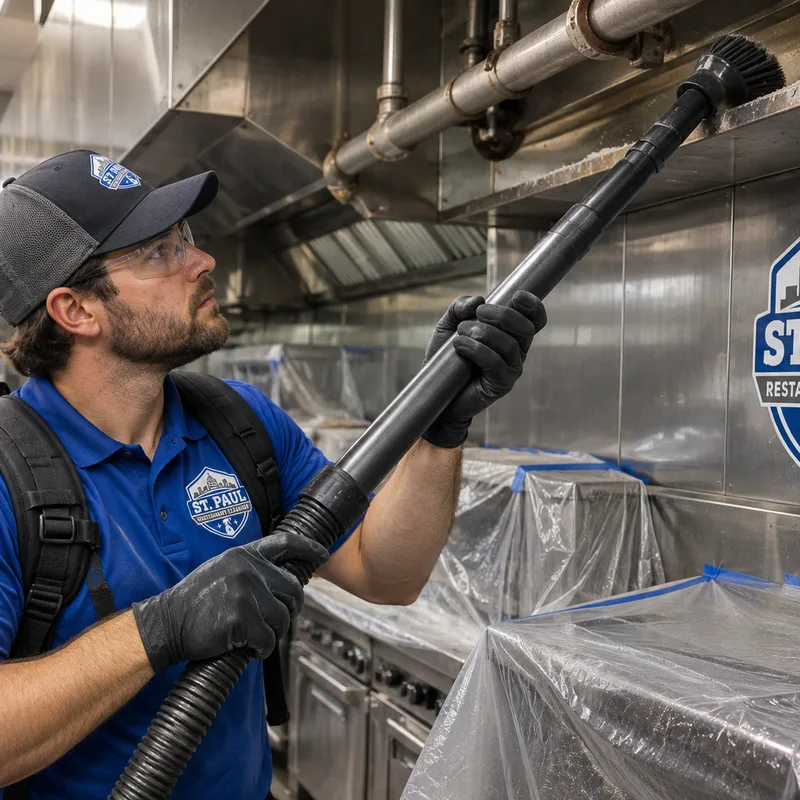
A technician using an extension vacuum tool to remove dust from overhead pipes and ledges in an empty commercial kitchen while lower equipment is protected.
Overhead surfaces are cleaned first so lower areas can receive their final cleaning afterward.

Our Process

How Restaurant Kitchen Cleaning Roseville Is Planned

  1. 01

    Discuss the Kitchen and Schedule

    We review the type of cooking, hours of operation, preferred service window, priority areas, and access requirements. This conversation establishes whether the work is a focused cleaning or a broader deep-cleaning visit.

  2. 02

    Inspect Conditions and Surfaces

    The walkthrough identifies grease levels, flooring, stainless steel, painted surfaces, overhead access, equipment clearances, and sensitive components. We also note which items restaurant staff must empty, cool, disconnect, or move.

  3. 03

    Set the Written Scope

    The plan lists included areas, exclusions, preparation duties, expected access, and the sequence of work. A clear scope helps managers coordinate food storage, staff departure, equipment shutdown, and reopening.

  4. 04

    Clean in a Controlled Order

    Crews generally begin with dry debris and high surfaces, then progress through degreasing, detail cleaning, and floors. Tools and products are matched to the surface rather than using one chemical throughout the kitchen.

  5. 05

    Review Before Turnover

    The completed areas are checked with the designated restaurant contact. We identify access restrictions or maintenance conditions observed during service and confirm that contracted surfaces are ready for the restaurant's reopening procedures.

Request a Callback

Service Preparation

Preparing the Kitchen for Service

Good preparation gives the crew safe access and protects restaurant property. Remove exposed food, disposable packaging, utensils, small appliances, and personal items from contracted areas. Empty shelves if their interior surfaces are included. Equipment should be cool before degreasing begins, and restaurant staff should handle gas shutoffs, electrical disconnection, or appliance movement unless the written plan assigns those tasks differently.

Tell the crew about damaged cords, loose tiles, leaking equipment, sensitive finishes, and drains that empty slowly. Product labels and manufacturer instructions guide chemical selection, especially on aluminum, painted surfaces, natural stone, and coated equipment. Testing an inconspicuous area may be appropriate when the finish is uncertain.

For overnight work during a Minnesota winter, managers should also coordinate door access so entrances are not held open longer than necessary. Snow, salt, and slush tracked through service doors can affect floor cleaning and drying. A clear route between the entry and kitchen reduces that problem and gives the crew room to bring in equipment safely.

Request a Callback

Ongoing Maintenance

Choosing the Right Cleaning Frequency

Cleaning frequency depends on cooking volume, menu, equipment arrangement, ventilation, and the restaurant's daily cleaning routine. Frying and high-heat cooking can create heavier grease deposits around a cook line. Flour, dry mixes, and open storage can add fine dust to ledges and overhead structures. A compact kitchen may need targeted detail cleaning more often because narrow gaps are difficult for staff to reach during service.

Some operators schedule a comprehensive cleaning at planned intervals and use smaller visits for floors, equipment sides, or overhead surfaces. Others arrange work before an inspection, after equipment changes, or ahead of reopening. The right plan is based on observed conditions rather than a fixed schedule applied to every restaurant.

A professional cleaning supports the restaurant's sanitation program, but management remains responsible for food safety procedures, employee cleaning duties, pest control, equipment maintenance, and compliance with applicable requirements. Cleaning records and a consistent internal checklist can help managers track recurring problem areas between professional visits.

Request a Callback

A walkthrough can turn a general cleaning request into a practical scope with clear preparation duties, priority areas, and timing that fits your restaurant's operating schedule.

Call for a Free Quote

Common Questions

Restaurant Kitchen Cleaning Questions

How much does restaurant kitchen cleaning cost in Roseville?

Pricing depends on kitchen size, grease level, equipment density, overhead access, and the number of areas included. A focused floor or cook-line cleaning requires less labor than a full deep clean with shelving, walls, equipment exteriors, and high dusting. An inspection provides the information needed for a written scope and project-specific price.

Can cleaning be scheduled after the restaurant closes?

After-hours cleaning may be scheduled when crew availability and building access allow it. Roseville restaurants near shopping and commuter corridors can have late closing routines, so the plan should account for equipment cooling, staff departure, alarm procedures, and enough drying time before morning preparation begins.

How long will a commercial kitchen cleaning take?

The time required is based on the scope, access, condition, and crew size. A targeted cleaning may fit within one closed period, while a large kitchen with heavy buildup or extensive overhead work may require a longer window. The expected duration is discussed after the kitchen has been evaluated.

Do restaurant employees need to move equipment first?

Restaurant staff should move or disconnect equipment only when they are authorized and the manufacturer permits it. The written plan identifies which units can be moved, who is responsible, and what must stay in place. Gas-connected, hardwired, or unusually heavy appliances should not be shifted casually for cleaning access.

Is high dusting safe around food-preparation areas?

High dusting can be performed safely when food, utensils, packaging, and clean equipment are removed or protected before work starts. Elevated surfaces are addressed early in the cleaning sequence, and lower surfaces receive their final cleaning afterward. Access tools and dust-control methods are selected for the height and layout.

Does kitchen cleaning include the exhaust hood and ductwork?

General kitchen cleaning does not automatically include internal exhaust ducts, fans, or fire-suppression components. Accessible hood exteriors may be included when specified, but internal exhaust-system cleaning is a distinct scope that may require a qualified provider. The proposal should state the boundary clearly.

What should managers do before the crew arrives?

Managers should remove exposed food and loose items, cool equipment, identify sensitive surfaces, and provide access to contracted areas. They should also report leaks, electrical damage, slow drains, alarm requirements, and any equipment that cannot be moved. These details help prevent delays during a Roseville after-hours service window.

Plan a Cleaner Roseville Restaurant Kitchen

Tell St. Paul Restaurant Cleaning about your kitchen, operating hours, grease concerns, and overhead access. We will discuss the work, preparation needs, and a clear scope suited to the space.