Cook-Line Grease
Restaurant floor degreasing breaks down the oily film that builds around fryers, ranges, ventilation equipment, and nearby traffic lanes.
Serving Saint Paul, Minnesota & surrounding areas
Open 24/7
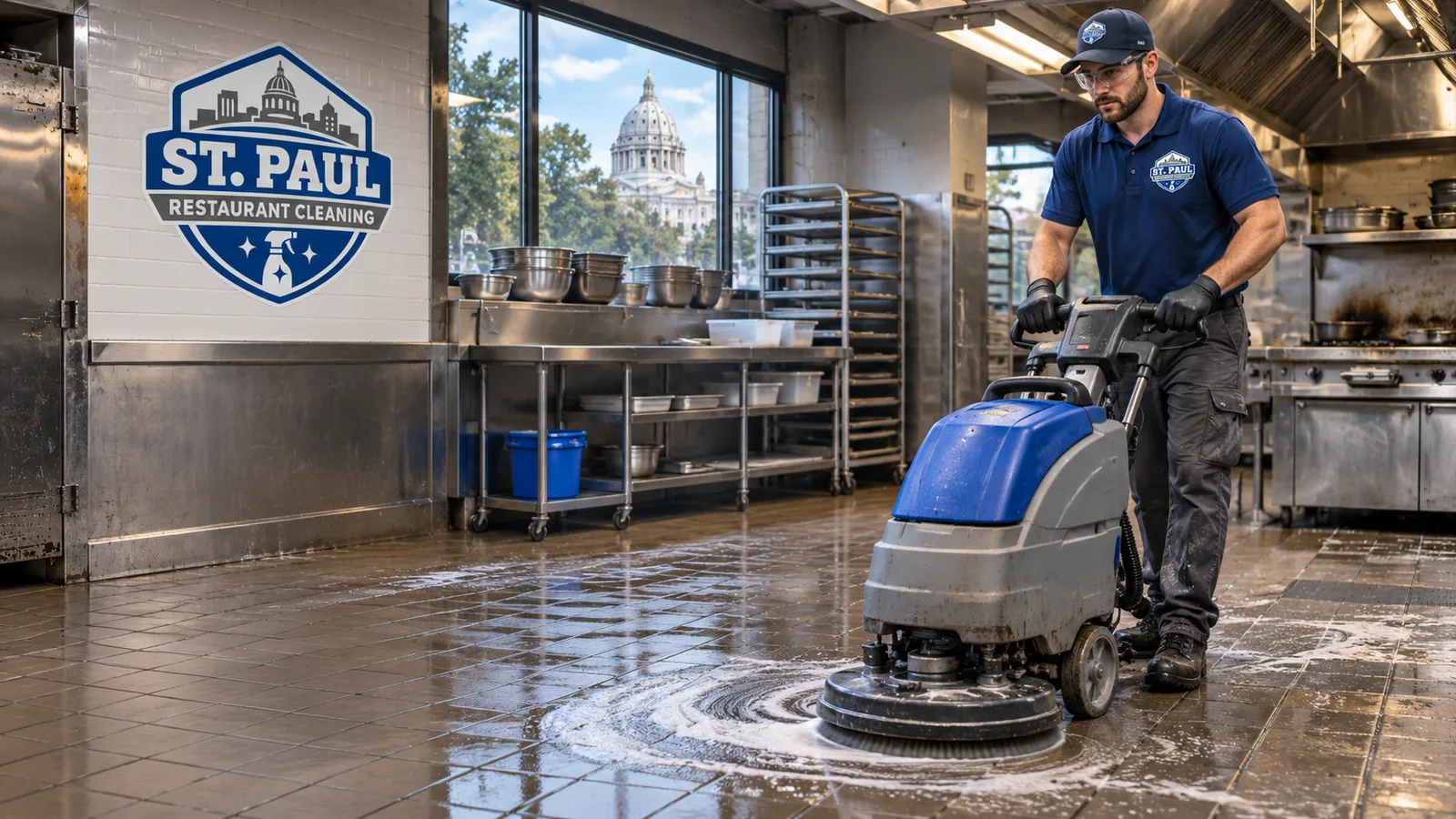
Kitchen Floor Cleaning · Saint Paul
Remove grease buildup, restore tile and grout, and give your restaurant a safer, cleaner floor with service planned around operating hours.
✓Grease buildup
✓Tile and grout
✓Soil recovery
✓Saint Paul based
Commercial Kitchen Floors
Commercial Kitchen Floor Cleaning targets the greasy film, embedded soil, food residue, and darkened grout that routine mopping often leaves behind. In a working kitchen, grease migrates from cooking areas into traffic lanes and settles in grout joints, textured tile, corners, and the floor around fixed equipment. Adding more detergent can make the problem worse when dirty solution is spread across the floor or allowed to dry.
St. Paul Restaurant Cleaning starts by assessing the floor material, soil load, drainage, access, and hours of operation. We are Saint Paul's trusted restaurant team, planning the work around the realities of food-service spaces rather than treating the floor like an ordinary commercial hallway. The scope may cover a focused cook line, the full back of house, or connected service and dishwashing areas. Before work begins, the restaurant receives a clear plan based on actual conditions.
Saint Paul kitchens also deal with tracked-in winter grit, salt, and slush. That abrasive soil can collect near receiving doors and employee entrances before being carried into production areas. Restaurants near downtown event traffic may face short cleaning windows, while neighborhood operations around Grand Avenue or West Seventh may need service coordinated with dinner and weekend schedules. These conditions affect timing, equipment access, and the cleaning sequence.
Tile and Grout Standards
Quarry tile and other textured commercial flooring are common choices for kitchens because they provide a durable working surface. Their texture and grout joints also trap grease and fine soil. A mop may remove loose debris while leaving a bonded layer behind, especially near fryers, ranges, prep stations, dish areas, and floor drains.
Restaurant tile cleaning begins with dry soil removal and application of a floor-compatible degreaser. The cleaner needs enough dwell time to break up greasy residue without drying on the surface. Mechanical agitation then reaches textured tile and recessed grout more effectively than a mop. The loosened solution is recovered rather than redistributed, followed by controlled rinsing and drying.
Restaurant grout cleaning requires careful attention to joint condition. Intact grout can be scrubbed and rinsed, but cracked, missing, or loose joints are maintenance defects rather than cleaning problems. Cleaning can reveal the true condition of the floor, yet it cannot repair failed grout or correct standing water caused by drainage or slope issues.
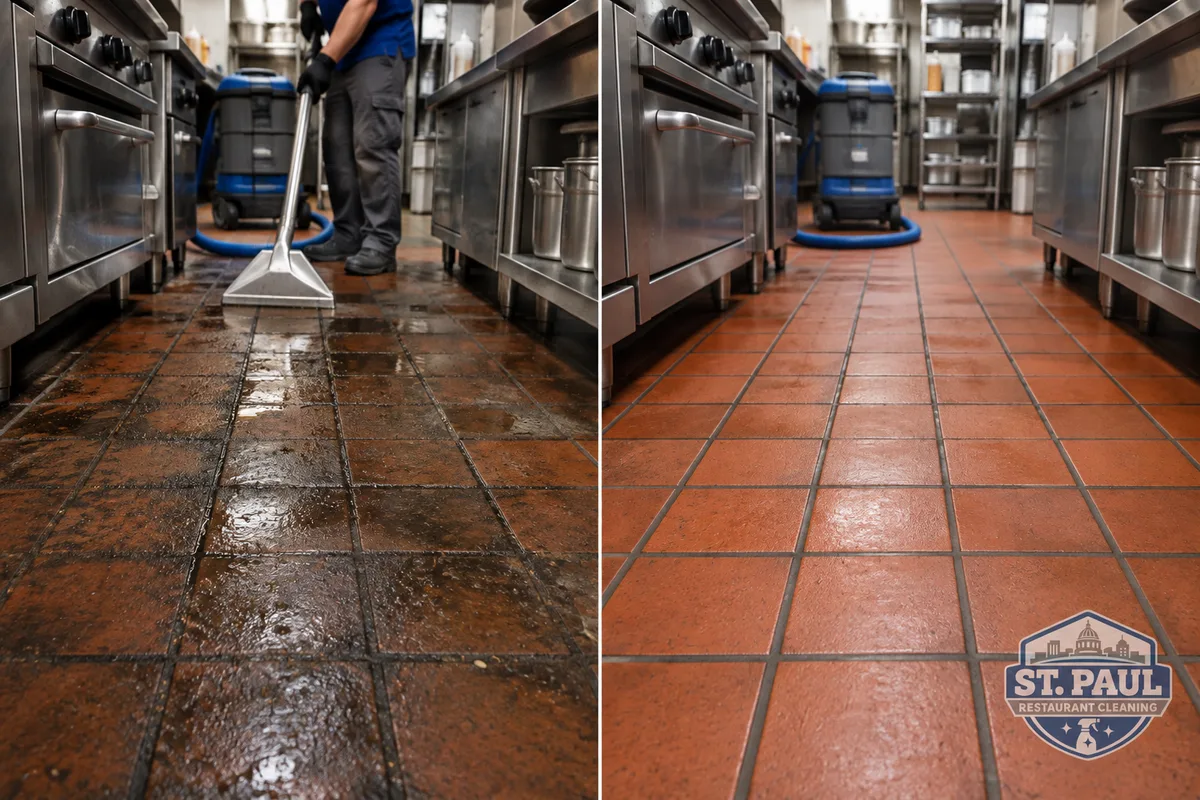
Restaurant floor degreasing breaks down the oily film that builds around fryers, ranges, ventilation equipment, and nearby traffic lanes.
Targeted agitation lifts embedded soil from sound grout joints, corners, wall edges, and other recessed areas a flat mop does not reach well.
Cleaning removes food soil, detergent film, and tracked grease around warewashing zones while accounting for drains and water-sensitive equipment.
Winter soil carried through receiving and staff entrances can be removed before it continues abrading the floor or spreading into production areas.
The scope can include compatible tile in server lanes, beverage stations, pickup areas, and dining spaces when those floors are part of the scheduled work.
A maintenance plan can be based on cooking volume, soil conditions, floor texture, operating schedule, and the results of the initial deep cleaning.
Our Process
We identify the flooring type, grease concentration, grout condition, drains, fixed equipment, damaged areas, and access limits. The assessment also establishes which spaces must remain available.
Loose debris is removed, movable items are cleared when included in the plan, and nearby surfaces or equipment are protected as needed. Heavy deposits may receive focused pretreatment.
A cleaner compatible with the floor is applied at an appropriate dilution. Controlled dwell time allows it to loosen oily soil before agitation begins.
Commercial equipment and detail tools scrub the field tile, grout joints, edges, corners, and accessible areas around equipment. Methods are adjusted for texture and floor condition.
Dirty solution is recovered, the floor is rinsed as appropriate, and remaining problem areas are treated again when needed. The final check notes damaged grout or other conditions cleaning cannot correct.
Moisture is removed and air movement may be used to support drying. Reopening timing depends on floor texture, room conditions, and the size of the cleaned area.
Local Operating Knowledge
A restaurant cannot treat floor cleaning like an open-ended project. Prep, deliveries, dishwashing, staff movement, and reopening all place limits on the available work window. We discuss those constraints before scheduling and divide larger spaces into workable zones when appropriate.
Downtown Saint Paul restaurants may need cleaning coordinated around office traffic, events, loading access, or shared building rules. Lowertown businesses often occupy commercial buildings where equipment movement and service access need advance planning. Along University Avenue, kitchens may have frequent delivery and takeout activity that affects when entrances and back-of-house routes can be closed. West Side restaurants may need special attention at receiving doors during snowy periods because winter grit and deicing residue enter through those paths.
Cleaning products and wastewater must be managed responsibly. Grease-heavy wash water should not be pushed outdoors or into a storm drain. The cleaning plan accounts for recovery, approved disposal routes, and any site-specific requirements. Food, utensils, and exposed preparation surfaces also need separation from floor-cleaning activity.
Pricing Factors
Commercial kitchen floor cleaning in Saint Paul typically costs about $0.30 to $0.75 per square foot, while small or heavily soiled jobs may carry minimum charges of roughly $250 to $500. Actual pricing depends on floor area, grease load, tile texture, grout condition, equipment access, required detail work, and whether cleaning must occur during a narrow overnight window. Moving equipment, repeated degreasing, or difficult wastewater recovery can add labor. The exact cost is confirmed after the kitchen and requested scope are assessed.
Request a CallbackCleaning Frequency
Schedule professional cleaning when the floor remains tacky after mopping, grout stays dark, grease returns quickly, or traffic lanes look different from protected areas. A slippery feel near cooking equipment is another reason to address buildup promptly. Cleaning can reduce removable surface contamination, but slip resistance also depends on flooring texture, footwear, spills, housekeeping, and whether the floor is allowed to dry.
The right interval is based on conditions, not a universal calendar. High-volume frying, textured tile, frequent deliveries, and winter soil may support more frequent service. A lower-volume kitchen with effective daily soil removal may need deep cleaning less often. Recurring Restaurant Floor Cleaning Services should complement daily sweeping, spill response, correct chemical dilution, clean mop water, and attention to floor drains.
We focus on verifiable floor conditions and explain where cleaning ends. Failed grout, broken tile, active leaks, poor drainage, and damaged transitions need repair by the appropriate trade. Identifying those limits prevents a cleaning proposal from promising a result the floor cannot support.
Get a written scope based on your floor material, grease buildup, access, and operating schedule before work begins.
Call for a Free QuoteCommon Questions
A focused kitchen area may take a few hours, while a large or heavily soiled back of house can require a longer shift or phased work. Floor area, grease buildup, equipment access, grout detailing, rinsing, and drying all affect the schedule. The work window should account for prep and reopening, especially for downtown restaurants working around events or shared-building access.
Accessible flooring around fixed equipment can usually be cleaned, but the exact reach depends on safe access and utility connections. Heavy appliances should not be moved without an agreed plan and qualified handling where gas, electrical, ventilation, or water connections are involved. The inspection separates accessible floor cleaning from equipment-moving work.
Cleaning can remove substantial grease and soil from sound grout, but it cannot restore missing, cracked, eroded, or permanently discolored material to new condition. Quarry tile joints near cook lines and dish areas often show wear once buildup is removed. Those defects should be evaluated for repair after the floor is clean and visible.
Professional degreasing is generally suitable for sound quarry tile when the chemical, dilution, dwell time, agitation, and rinse method match the floor. An inspection is needed because grout condition, sealers, coatings, previous chemicals, and adjacent materials can change the method. A small test area may be appropriate when the floor history is unknown.
After-hours scheduling may be available when staffing, building access, cleaning time, and drying time support it. Saint Paul restaurants should also account for locked loading areas, shared property rules, overnight security, and winter access. The schedule is confirmed before service so the floor is ready for the next planned use.
Staff should remove dry debris first, clean spills promptly, use the correct detergent dilution, change dirty solution, and leave the floor as dry as practical. Greasy mop water should not be carried across clean zones. Entry mats and frequent soil removal are particularly useful during Saint Paul winters, when salt, grit, and moisture enter through staff and receiving doors.
Floor cleaning does not include tile replacement, grout repair, drain repair, waterproofing, or correction of improper floor slope unless those items are specifically quoted by a qualified provider. Cleaning often makes defects easier to identify. Any cracked tile, open grout joint, leak, or standing-water problem should be handled as a separate repair.
Tell St. Paul Restaurant Cleaning about your floor material, problem areas, operating hours, and access needs. We will help define a practical cleaning scope and schedule for the space.